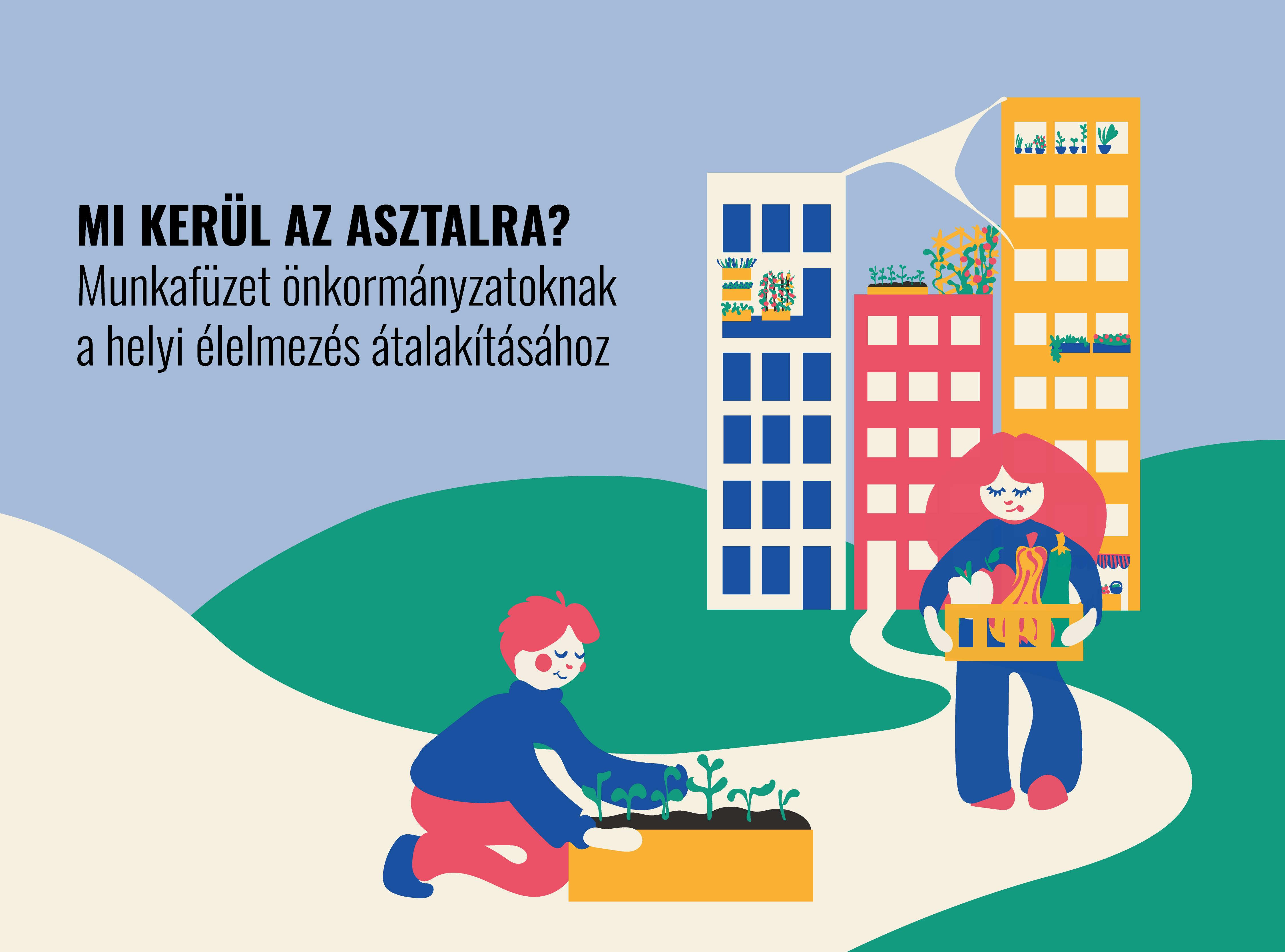
We developed the textbook What Ends Up on Our Tables? – A workbook for local governments to transform local food systems to help reflect on what a local government can do these days when it comes to food and nutrition, even with small investments. The workbook is in Hungarian and provides questions and frameworks with which decision-makers and municipal staff can assemble their own city’s strategy and set their food system on a more sustainable path both environmentally and socially.
Food is a difficult topic for municipalities as it is everywhere and nowhere at the same time. There is no such thing as a “department of food,” yet food is present in public education, social care, healthcare, urban operations, asset management, waste management, chief architect duties, climate, and economic development affairs.
This simultaneously means bad and good news. Bad news because something that belongs to everyone, really belongs to no one – it has no owner, no dedicated budget, and no indicators. Good news because it can be linked to almost every existing municipal task, meaning there is no need to start from scratch, and no separate funds are required for the first steps.
Our workbook briefly outlines why it is so important to think and act at an urban scale while also integrating policy domains to successfully transform the food system and make it more sustainable and equitable. It contains fillable exercises and presents numerous good practices from initiatives in Hungary and abroad.
Those who complete the workbook will go through the following steps:
- map out the linkages: which municipal areas are affected by food
- take stock of their own tools: what their municipality currently does as a caterer, procurer, landowner, or regulator
- name the problems at every stage of the food system’s chain, using concrete local examples
- list potential partners (including those within the administration)
- identify existing local initiatives that can be built upon
- explore possibilities for broader cooperation: networks, neighboring municipalities, twin towns
- select an idea and write a plan for it
- gather resources for implementing the plan (both grant-funded and non-grant-funded)
The workbook may be of interest not only to local governments; civil society organizations, educational institutions, green infrastructure planners, or even residential communities can draw knowledge and ideas from it.
The workbook can be downloaded HERE,
and can be flipped through here:
Please wait while flipbook is loading. For more related info, FAQs and issues please refer to DearFlip WordPress Flipbook Plugin Help documentation.
The authors of the publication are Bálint Balázs, Éva Bánsági, and Vanda Pózner, who wrote the workbook during their work on the FoodCLIC Project. The work is available under the Creative Commons Attribution–NonCommercial 4.0 International (CC BY-NC 4.0) license.