Cultural barriers are the main obstacle to scaling legume consumption, and the research is detailed on the benefits. So why don’t legumes scale? We mapped six real dilemmas that farmers, processors, and consumers face when the system’s incentives point the wrong way.
Experts across Europe agree that legumes reduce the profit-versus-environment
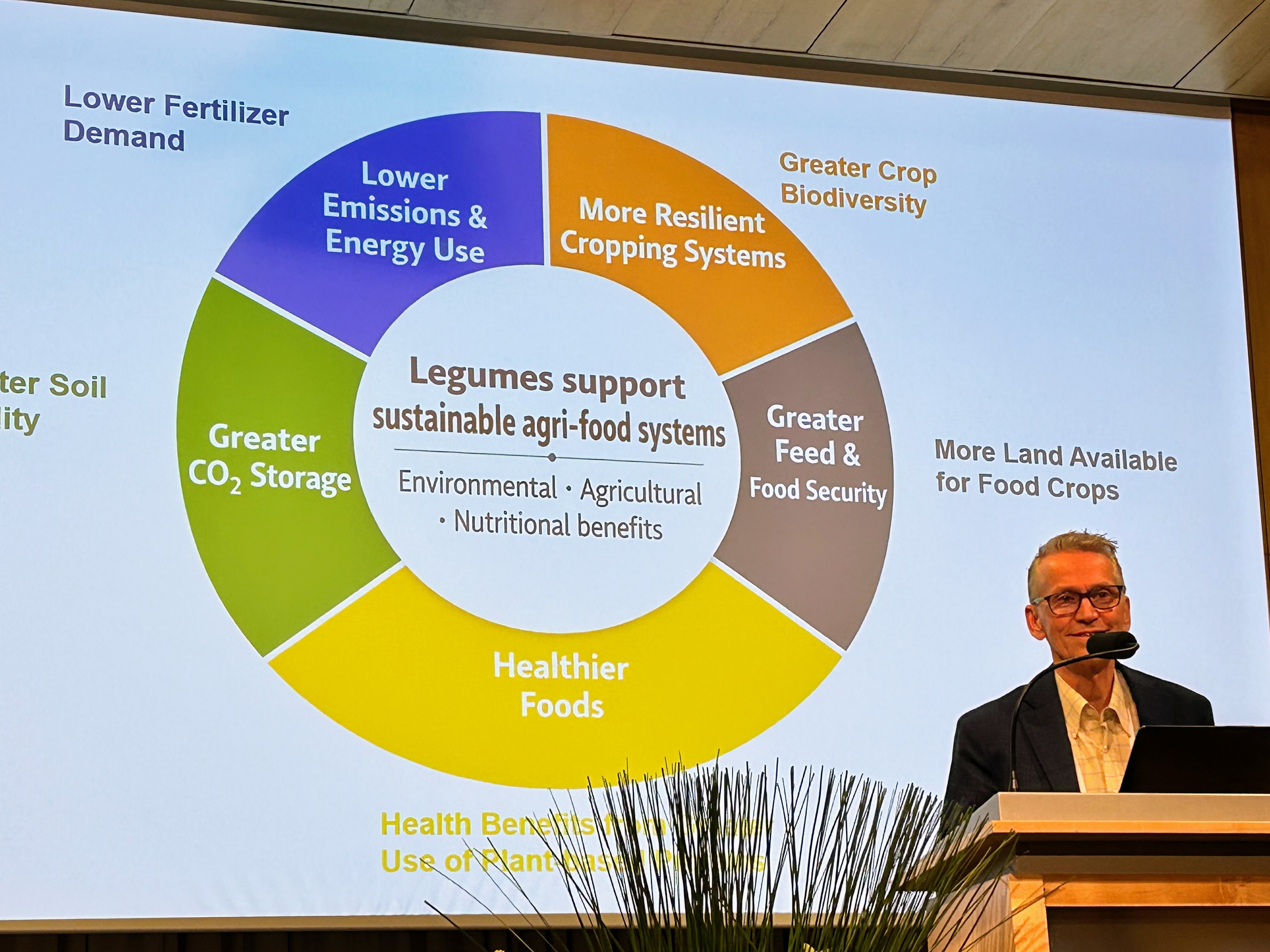
So why is legume area, consumption, and market development across Europe still so low?
At ILS5, Bálint Balázs addressed this question in a talk and a poster co-authored with Ágnes Neulinger and Kata Fodor, exploring the trade-offs and tensions that continue to hold back progress. Developed as part of the legumeES project, the poster – Legume Dilemmas: Benefits and Trade-offs of Legume-based Crop and Food Systems – draws on insights from a Delphi study involving 43 experts from 15 countries and highlights the complex challenges surrounding legumes. Experts’ views converged strongly on the benefits: 83% agree that optimal legume proportions improve productivity and economics in intercropping; 81% agree that legume-grass intercropping boosts both productivity and ecosystem support; 69% agree that legumes reduce the profit-versus-environment trade-off at the farm level.
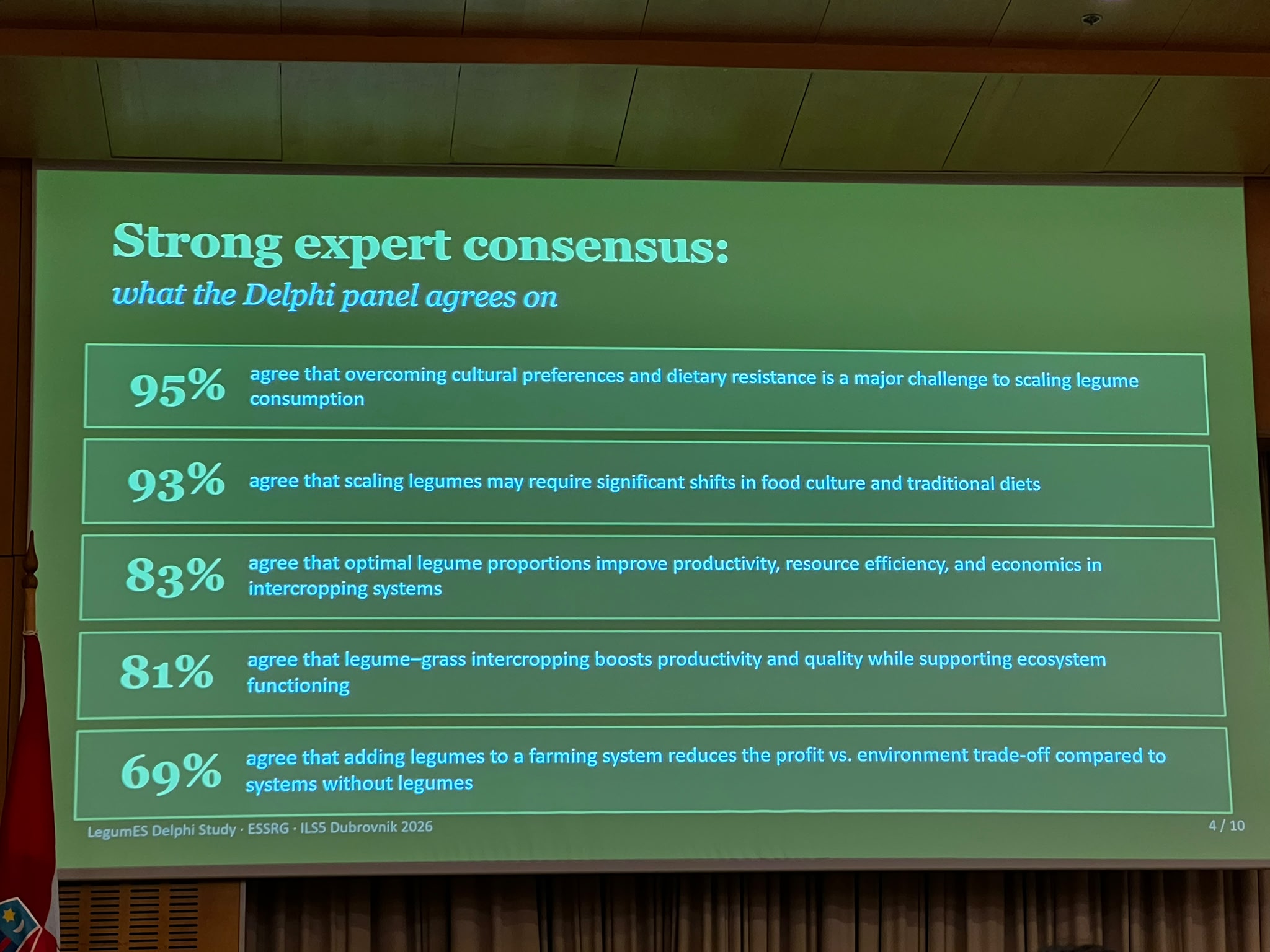
But they converged just as strongly on what the scale-up runs into. 95% agree that overcoming cultural preferences is a major challenge to scaling legume consumption, and 93% agree that scaling may require significant shifts in food culture and traditional diets. These are clearly not technical, agronomical, breeding, or ecological problems. What’s more, the trade-offs the experts identified tell the same story. The sharpest tension found by 79% of respondents is plant diversity versus seed marketisation: the commercial seed system, with its standardised, high-volume varieties and the diversity of varieties farmers have developed, is pulling in opposite directions.
Intercropping also does not fit easily with modern farming machinery or established pesticide-based practices (64%). Likewise, experts found the conflict between strengthening local, resilient supply chains and competing in globalised markets highly relevant (64%), as well as the challenge of making legume-based foods affordable for consumers while ensuring fair prices for farmers (61%). All this rounds out a picture of a system with competing priorities, not simply missing information or political will.
We put these tensions into evidence-based terms, drawn from real situations across European legume systems, and each one poses a genuine dilemma with no easy answer.
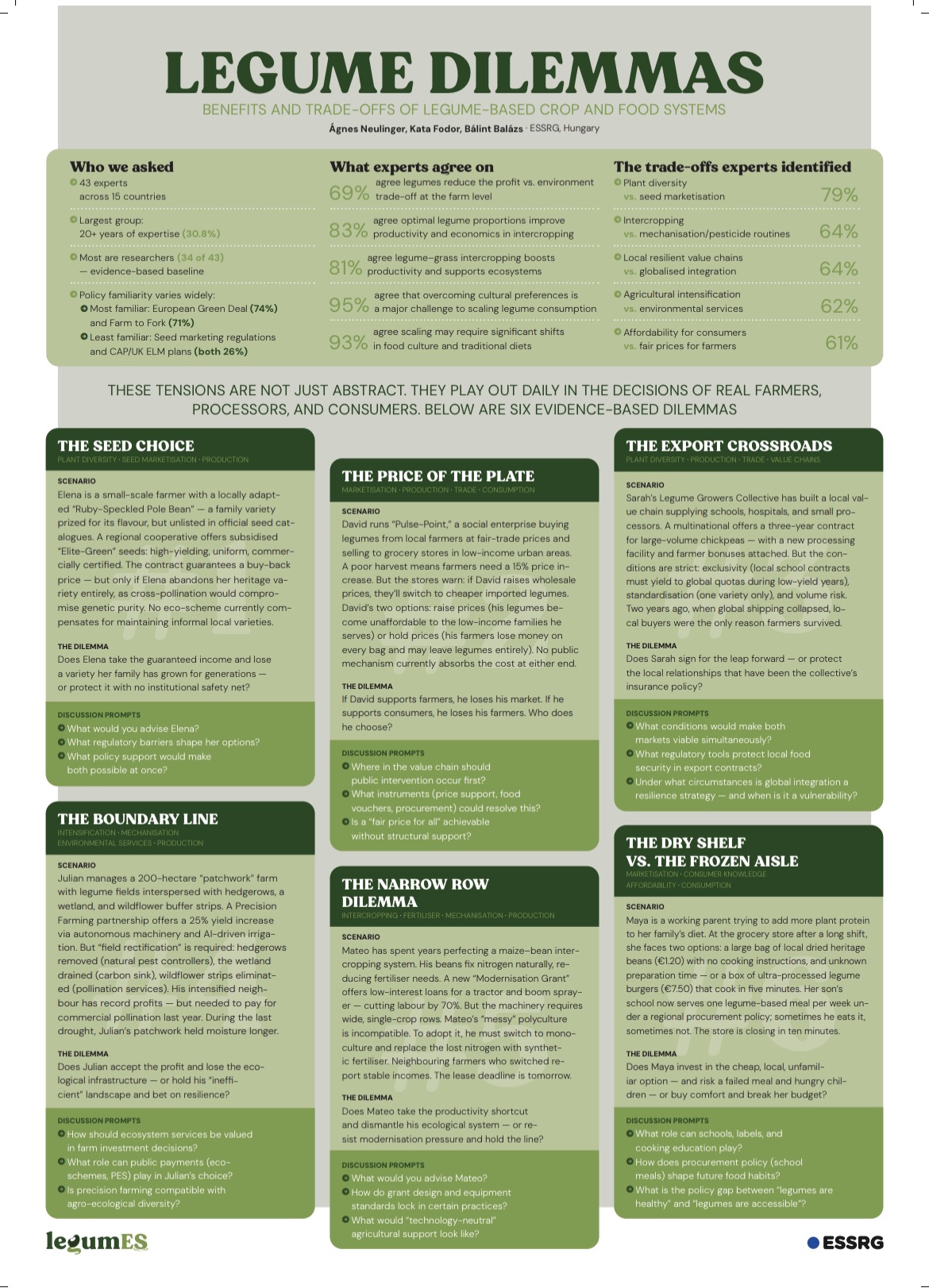
The gap between “legumes are good” and “legumes are everywhere” runs through every one of these decisions, and no amount of agronomic research closes it on its own.
This research in LegumES forms part of ESSRG’s wider effort to understand why crops with proven environmental and nutritional value remain marginal in European food systems and what it would take to change that.
The COUSIN project addresses the same structural gap for crop wild relatives: the genetic material needed to breed more resilient, lower-input varieties exists in genebanks and wild populations, but sustained pre-breeding capacity, well-characterised material, and policy conditions to make it usable are consistently missing. ESSRG leads policy and stakeholder engagement work across five flagship crop groups — wheat, barley, pea, lettuce, and brassicas.
The RADIANT project (H2020) examined the governance structures around underutilised crops that have been pushed to the margins by a policy and market architecture built around cash crops. The trade-offs RADIANT found echo the legumES dilemmas almost exactly: institutional support flows to the narrow base, and diversification faces structural headwinds regardless of its merits.
The TRUE project (H2020) produced a multi-country policy analysis of European legume systems, showing a self-reinforcing trap: low demand discourages production, low domestic supply pushes processors toward imports, and imports undermine the price signals that would encourage local growing. Breaking the trap requires coordinated action across CAP instruments, labelling, procurement, and research funding.
The common takeaway from all of this work is that science is ahead of food systems transformation. Research has done its homework. The constraint is in the policy, market, and institutional frameworks that govern what farmers, processors, and consumers can actually do.
ILS5 confirmed this pattern from every direction. Keynotes on ecosystem service monitoring, wild relative use in resistance breeding, and value chain governance all noted that research capacity and practical use are misaligned, and that the gap is not scientific.
The necessary policy framework does not yet exist, while value chain actors are making irreversible decisions now. That is the case for urgency.