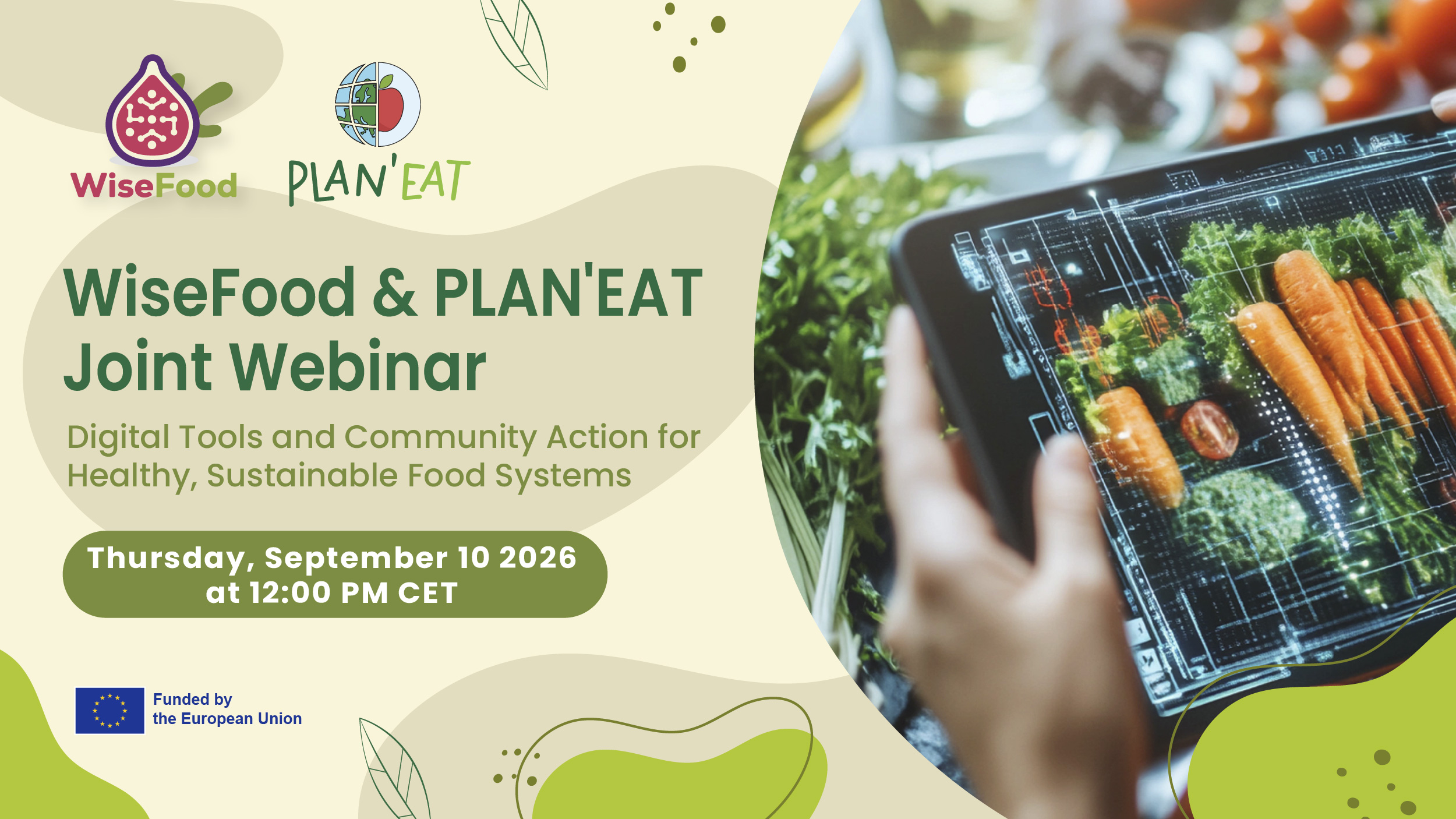
On 10 September 2026, ESSRG brought together two EU-funded research projects – PLAN’EAT and WiseFood – for a lunchtime webinar on Digital Tools and Community Action for Healthy, Sustainable Food Systems. The session focused on a simple but important question: how do community-based approaches and digital solutions work together, not just alongside each other, in the transition to healthier, more sustainable diets?
Around 45 participants – community developers, researchers, food system practitioners, Living Lab facilitators, policymakers, public health professionals and civil society representatives – joined to hear from both consortia and to compare notes on what four years of fieldwork and prototyping have taught them.
Two projects, one question
PLAN’EAT has spent four years co-creating knowledge and interventions through a pan-European network of nine Living Labs and a Policy Lab. Its focus has been on dietary patterns, food environments, and behaviour change across diverse groups, including single-parent families, older adults, and low-income households. Outputs include a True Cost Accounting database, a Food System Dashboard, and consumer advisory tools and targeted interventions across the food chain. Juliette Soudon (Euroquality) opened the project introductions, and Vanda Pózner (ESSRG) walked participants through the Living Lab network and the community-level interventions co-designed with vulnerable groups.
WiseFood, presented by Dimitris Skoutas and Dimitris Petrou (Athena Research Centre), takes a different entry point: AI-powered digital applications that help people make healthier, more eco-friendly food choices. Its three tools – FoodScholar (a natural-language interface to trusted food data), RecipeWrangler (nutritional and environmental recipe analysis) and FoodChat (personalised meal planning) – have been co-designed and tested in Living Labs in Ireland, Slovenia and Hungary.
Dr Piroska Kállay (European Economic and Social Committee) opened the session with a wider policy frame that ran through the rest of the hour: an EU-level food policy network is currently taking shape, and a growing number of member states are being encouraged to set up equivalent structures of their own. Her point was that this kind of policy infrastructure, not just individual projects, is what turns good food systems research into political will. Without a network that keeps policymakers, researchers and practitioners talking to each other between projects, evidence like PLAN’EAT’s and WiseFood’s risks staying evidence rather than becoming policy. Tamara Kozic (GreenPoint LL, Slovenia) closed the formal presentations by drawing out the importance of meaningful community engagement and Living Lab methodology.
With both projects and that policy backdrop on the table, the floor opened up, and the conversation got most interesting. The questions participants raised in the chat, in real time, tracked almost exactly onto the open problems both projects are still wrestling with. A few themes stood out.
What the chat told us
Engagement is not evenly distributed. The first question that emerged was: how do you reach people who’d benefit but are held back by other life pressures? Vulnerable groups are far more heterogeneous than often this framing suggests, and the interventions that worked stayed flexible enough to be redesigned mid-course rather than delivered as a fixed programme.
Interventions need a life after the project ends. The same question, raised independently by two different attendees, was about sustainability once EU funding closes. Is there a place for government-funded, or -backed tools, the way dietary guidelines are issued? The discussion pointed to two ways forward: keeping continuity with the same vulnerable groups by carrying them from one project into the next, rather than dropping the relationship when a funding cycle ends; and building on the multi-stakeholder network each project already assembles, so that other actors, like local municipalities, cities among them, can pick up and run similar interventions themselves.
Trust has to travel with the data. How is GDPR implemented across the applications, how much control do users have over their own data, and can data move between tools at all? These questions weren’t resolved live, but they flagged that the AI-powered side of the conversation needs its own transparency and interoperability standards.
Tools have to fit the kitchen people actually have. One participant asked how tool design and promotion account for limited tech literacy or access to technology, and whether primary healthcare channels could reach populations who wouldn’t otherwise find these tools. Another pushed this further with a concrete case: food bank users who receive only 10–12 items with no choice, often no fresh produce, only ambient food. Can a recipe or meal-planning tool meaningfully adapt to that starting point, rather than assuming a stocked kitchen and a grocery budget? A third added a related, practical gap in RecipeWrangler: cost is not yet part of the recipe analysis, even though cost is often the deciding factor in what a family cooks that week.
Depth and reach can scale together. The closing question from the chat named the scaling problem directly: Living Labs work with small citizen groups, tens to a couple of hundred people, so what does it take to scale that to a city, region or country? PLAN’EAT and WiseFood are, in effect, already splitting this work between them: one scaling deep, embedding change in specific communities, the other scaling out, reaching more people with the same tools. Done separately, either move alone would fall short. Done together, they cover more of what real scaling actually requires.
Where this leaves us
The organisers made sure the conversation didn’t end there: the closing block focused on where to go next, and what form future collaboration between the two consortia, and beyond them, could realistically take. Concretely, that means legacy planning: joint publications, policy briefs, and follow-up activities that keep these open questions alive past the webinar itself.
Which is, in the end, the whole point of putting these two projects in the same room: neither community engagement nor digital tools get us to meaningful food systems transformation alone, but together, they might.
The full recording of the session is available on the ESSRG YouTube channel. A longer discussion piece exploring these themes in more depth is forthcoming.
Vanda Pózner